Showing posts with label tourism. Show all posts

Monday, September 17, 2007

The sand-engulfed Buried Church, Skagen, Denmark


The desertification that hit the area in the 18th and 19th centuries led to the abandonment of the old parish church to the migrating sands— the famous Buried Church (Den tilsandende Kirke). The tower of the church remains protruding from the dunes, as it was left as a sea marker when the church was abandoned at the close of the 18th century.

Thursday, September 6, 2007

Travel: Check your spelling!


Rhodos
The Cathedrale of Notre-Dame in Rodez, France

Three Norwegian tourists who believed they were on their way to the white beaches of the Greek holiday island of Rhodos, ended up in a French medival mountain village.

The three, Bente, Marit and Knut were more than surprised when their plane on Monday landed in the city of Rodez in south western France, north of Toulouse.
The town is proud of its old city centre which dates back to around 1200, but it is far from the Rhodos beaches.
The problem was caused by a slight keying error when the three ordered their tickets via internet.
In the end, they decided to return to their home mountains in Norway.

Friday, August 17, 2007

The Nærøyfjord


The Nærøyfjord (Nærøyfjorden) , Norway,maybe the worlds most beautiful and dramatic fjord? It is about 20 kilometers long, and a branch of the large fjord Sognefjord.
Since 2005, the Nærøyfjord is listed as a UNESCO World Heritage Site.
Nærøyfjord is an adventure. Experience it from boat, in kayak or by walking in the surrounding mountains and green valleys. Breath in the fresh air and drink the pure water straight from one of many waterfalls and rivers ending into the fjord. Listen to the silence, to the nature, to the sounds from the waterfalls. Listen to the sound from the fjord...
I just love this fjord, it's my favorite....

Monday, June 11, 2007

Goat of Svolvaer (Svolværgeita)


The Svolvær Goat is one of the most popular climbing pinnacles in Norway. Who can resist the lure of climbing multipitch solid rough granite, then taking the leap from one horn of the goat to the other?

The Goat wasn't climbed until 1910 by Carl Rubenson, Alf B. Bryn, and Ferdinand Schjelderup. It was during the same climbing trip that they also were the first atop Trakta (the Funnel) and Stetind. Climb these summits today by their original routes, and you'll see how hot this trio was!

Svolværgeita has many routes, but all end at the Storhorn (big horn) with the following jump to the Lillehorn (little horn). The jump is 1.5 meters across, and about a meter down. It's the perfect climbing stunt, because it is just possible, but hard enough to give one pause.

Saturday, June 2, 2007

Port of Molde


Rica Seilet Hotel is North-Western Norway's most complete and flexible hotel for culture and conferences. Part of the hotel just out into Romsdalsfjorden, with superb views of the surrounding mountains, with peaks above 1,000 metres. Rica Seilet Hotel is centrally located next to Aker Stadium, within walking distance of central Molde.

Tuesday, May 29, 2007

Photo from the troll road (Trollstien)


Trollstigen, in the heart of Romsdal, is one of the best visited attractions in Norway. The mountains which encircle the Trollstigen road are enormous. Names like Kongen (the King), Dronningen (the Queen) and Bispen (the Bishop) confirm their majesty in this mountain world.

Saturday, May 26, 2007

Norwegian Fjords rated highest


The Norwegian Fjords Geirangerfjord and Naeroeyfjord have been rated highest on the National Geographic Traveller's Index of Destination Stewardship, covering 115 World Heritage destinations around the world.

The magazine wanted to find out which national heritage destinations have been able to protect themselves against the pressures of development, environmental problems, civil strife, cultural erosion, and, yes, mass tourism.

It's no surprise that Norway's fjords, rated at 82, lead the top-scoring destinations, thanks to a combination of luck and wise stewardship. Geography dealt the Norwegian coastline a good hand when it comes to remaining unspoiled. Rugged terrain, cool, wet climate, difficult access, and a short tourist season keep development pressures comparatively low.

Monday, May 21, 2007

Hurtigruten (Coastal Express)


Hurtigruten or Hurtigruta (English: Coastal Express) is a Norwegian passenger and freight line with daily sailings along Norway's spectacular west coast. Ships sail almost the entire length of the country, completing the roundtrip journey in 11 days. The trip has been described as the "World's Most Beautiful Sea Voyage.

Monday, May 14, 2007

Finnchurch, an odd cliff


Finnkjerka which is said to be the most graceful sea cliff in Norway. Finn-Church is a ancient Saami sacrificial site.

Thursday, May 10, 2007

The Geiranger Fjord (Geirangerfjorden)


The Geiranger Fjord is considered one of the most scenic spots in the world.

Foreign visitors are discovering the scenic fjord of western Norway in record numbers.

Tourists to Norway's western fjord counties continue to increase. In the first quarter of 2007 985,000 overnight stays were recorded at hotels, camping sites and rental cabins in the area.

Friday, April 27, 2007

Hardangerfjord, Norway


With a length of 179 km (111 miles), the Hardangerfjord in the county of Hordaland in Norway is the third largest fjord in the world and the second largest in Norway. The surrounding district is called Hardanger.
About 10,000 years ago the Scandinavian land mass started to rise up as enormous glacial ice started to melt. The lower parts of the valleys became flooded, and so created what we today know as the Hardangerfjord. The valley was originally not only made through glacial erosion but by the high pressure melting water which pushed its way beneath the ice.

Wednesday, April 25, 2007

My favorite mountain, Hamarøyskaftet


One of the oddest mountain in Nordland, climbed for the first time in 1885. Hamarøyskaftet is a landmark and are approximately 612 metres.

Tuesday, April 24, 2007

Rising seas threaten Bergen


Climate change and rising sea levels are posing huge threats to the historic city of Bergen on Norway's west coast. Large areas of downtown face submersion, and the ancient wharf known as Bryggen is especially vulnerable.

A sudden fall in groundwater levels under Bryggen, years of settling and frequent flooding are endangering the structural stability of the complex, which dates back to Viking times. The wharf's current buildings stem from the early 1700s, rooted in the latter days of the Hanseatic League.
Bryggen (Norwegian, "The Wharf"), also known as Tyskebryggen ("the German Wharf") is a series of Hanseatic commercial buildings lining the eastern side of the fjord coming into Bergen, Norway. Bryggen is on the UNESCO list for World Cultural Heritage sites. The name has the same origin as the Flemish city of Brugge.

Sunday, April 22, 2007

Lofoten, a beauty in Norway


Lofoten is an archipelago and a traditional district in the county of Nordland, Norway. Though lying within the Arctic Circle, the archipelago experiences one of the world's largest elevated temperature anomalies relative to its high latitude.

Lofoten is located at the 67th and 68th degree parallels North of the Arctic Circle in Northern Norway. It is well known for its exceptional natural beauty within Norway.

Thursday, April 19, 2007

North Cape (Nordkapp)

The midnight sun

The municipality's most famous point, after which it is named, is Nordkapp (North Cape). This 307 m high cliff is usually referred to as the northernmost point of Europe. Some 200,000 tourists visit annually, during the two to three months of summer. The neighbouring point of Knivskjellodden is, however, some 1,500 m further north.

Sunday, April 15, 2007

The Holmenkollen ski jump


The Holmenkollen ski jump, located in Holmenkollen, Oslo, Norway, is host to the world's second oldest ski jump competition still in existence.

Since then crowds have increased to over 100,000 and the jump has been extended 18 times, last time in 1982. Today's tower extends 60 meters above ground, and 417 metres above sea level. The current record is 136 meters.
Crown Prince Olav participated in 1922 and 1923. Every year, more than a million tourists visit the ski arena. The tower offers a panoramic view of Oslo and the Oslofjord.

Friday, April 13, 2007

Nidaros Cathedral (Nidarosdomen)


Nidaros Cathedral (Nidarosdomen), considered the most significant church of Norway, is located in Trondheim. It was the cathedral of the Norwegian archdiocese, established in 1152. Since the Reformation, it has been the cathedral of the Lutheran bishops of Trondheim or Nidaros. The architectural style of the cathedral is romanesque and gothic. It was an important destination for pilgrims coming from all of Northern Europe.

Thursday, April 12, 2007

The Arctic Cathedral


The Tromsdalen Church (Tromsdalen Kirke), which is more commonly known as The Arctic Cathedral (Ishavskatedralen), is a church in Tromsø, Norway, built in 1965. The church is a parish church and not, strictly speaking, a cathedral.

Because of the church's distinct look and situation, it has often been called "the opera house of Norway", likening it to the famous Sydney Opera House in Sydney, Australia. The church is probably the most famous landmark in Tromsø.

Tuesday, April 10, 2007

Pulpit Rock (Preikestolen)


Preikestolen or Prekestolen, also known by the English translations of Preacher's Pulpit or Pulpit Rock, and by the old local name Hyvlatonnå, is a massive cliff 604 metres above Lysefjorden, Norway. The top of the cliff is approximately 25 by 25 metres, square and almost flat, and is a famous tourist attraction in Norway.

The walk to Preikestolen is partly very steep. The path starts at the Preikestolhytta Youth Hostel at a height of approximately 270 metres, and climbs to 604 metres. The trip is estimated to 2 hours, but that is with children and/or many pauses. It can be completed in 1 hour by experienced hikers. Even though the height difference is only 330 metres, and on the map the trip is only 3.8km (each way), the actual hike is much more as the path goes up and down various ridges.

Saturday, March 17, 2007

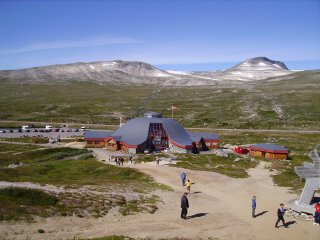
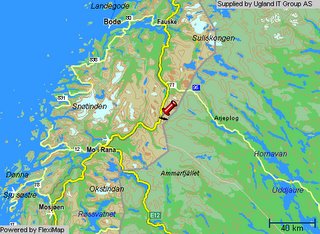
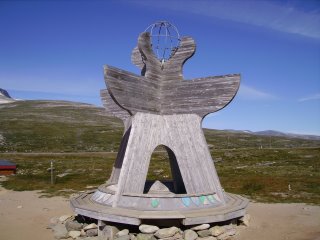
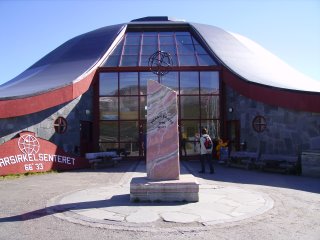
The Arctic Circle Center in Norway


Mo I Rana and the Arctic circle area is the gateway to the arctic Norway. Here you can see the Midnightsun in summer, and experience complete darkness and the Northern Light in Winter. Arctic circle Norway Is otherwise an eldorado for those who like outdoor activities. With Norway's largest archipelago, Northern Skandinavias largest glacier, and the fact that Saltfjellet- Svartisen Nationalpark is a part of the largest wilderness area in Europe, anyone and everyone should find something of interest.
If I also mention a number of caves, potholes, glaciers, rivers, lakes, mountainformations, beaches, festivals, sami cultur, coast cultur, city cultur and Industrial history, and it's obvious that there's a lot to do. Of activities we can only mention a few like for example: diving, kayaking, hiking, fishing, biking, islandhopping, climbing, skiing, glacier walking, horsebackriding and much, much more. You are all welcome to visit our beautiful area.